The weighting of a course (e.g., 3-1-3) represents the distribution of the workload in hours per week associated with that course.
1st number = theoretical instruction
2nd number = laboratory work or internship
3rd number = independent study
The weighting of a course (e.g., 3-1-3) represents the distribution of the workload in hours per week associated with that course.
1st number = theoretical instruction
2nd number = laboratory work or internship
3rd number = independent study
This course develops the mathematical foundations required for aeronautical applications. Students will learn to model situations, perform algebraic, trigonometric, and vector calculations, solve systems of equations, and interpret technical results. The course combines theory and practice to strengthen skills related to analysis and problem-solving in an aeronautical context.
Ce cours d’introduction permet à la personne étudiante de découvrir les métiers de l’aéronautique en explorant les fonctions de travail, les milieux professionnels, les exigences règlementaires et les comportements attendus dans le domaine. À travers des activités variées (visites, recherches, simulations, travaux pratiques), elle développera sa compréhension du cadre normatif, de la terminologie spécialisée et des conditions d’exercice propres aux secteurs de la maintenance, de l’avionique et du génie aérospatial. Ce cours constitue une base essentielle pour la poursuite des apprentissages dans les programmes techniques du domaine.
This course introduces students to the safe and proper use of tools and equipment commonly used in aircraft maintenance. They will learn to select the appropriate instruments for the tasks at hand, to fabricate simple components, and to apply safety and cleanliness standards in the workshop. The activities, primarily hands-on, take place in a hangar or workshop and aim to develop essential skills for handling aeronautical tools according to industry standards.
This course introduces students to the interpretation of plans, technical drawings, and specifications related to aircraft components, assemblies, and systems. They will learn to identify parts, understand standardized symbols, and extract the technical information necessary for maintenance. The activities, combining theory and practice, aim to develop essential skills for reading plans in a work environment in compliance with aeronautical industry standards.
This first-semester course deals with the aerodynamic principles applied to aircrafts. Students will learn to establish links between the various aerodynamic principles influencing the behavior of an aircraft and its components (the airframe, flight controls, propeller operation, and structural and surface repairs).
This course focuses on the operation and verification of aircraft turbomachinery. Students will learn to identify components, interpret technical documentation, perform functional tests, and analyze results. Activities combine theory and laboratory work to develop essential skills for planning maintenance activities on turbine engines, in accordance with Transport Canada standards.
This course introduces differential and integral calculus as applied to aircraft maintenance. Students will learn to model technical phenomena, solve equations, analyze experimental data, and interpret results in real-world contexts. The course combines theory, practice, and numerical tools to develop the essential mathematical skills for technical analysis and decision-making.
This course develops the principles of strength of materials as applied to aircraft maintenance. Students will learn to perform calculations of forces, moments, and stresses, conduct mechanical tests, and apply heat and corrosion treatments. The course combines theory and practice to strengthen skills related to the analysis and reliability of aircraft components.
This course focuses on the application of techniques for shaping, assembling, and installing aeronautical components according to industry standards. Students will learn to interpret technical drawings, operate specialized tooling, fabricate and install parts, and verify the conformity of their work. The activities, combining theory and practical experience in the laboratory and hangar, aim to develop essential skills for performing work safely and in accordance with aeronautical standards.
This course introduces students to the properties, selection, and use of fuels, lubricants, plastics, and solvents used in aeronautics. Through theoretical and practical activities, they will learn to analyze the characteristics of these materials, perform quality and contamination tests, and apply current safety and environmental standards.
This course introduces students to the operation of aircraft piston engines and their related systems. They will learn to identify components, interpret technical documentation, detect malfunctions, and perform functional tests according to industry standards. The activities, combining theory and practical laboratory work, aim to develop essential skills for the verification, analysis, and adjustment of piston engines for safe and compliant maintenance.
This third-semester course is common to both the Aircraft Maintenance Technology and Avionics Technology programs. Students will analyze the responsibilities of a future aircraft maintenance technician (AMT) in order to perform maintenance activities while taking into account Canadian civil aviation regulations and standards, as well as standard practices recognized by the aircraft maintenance community.
This course focuses on techniques for cleaning, inspecting, and repairing minor damage to aircraft structures and components. Students will learn to identify and assess damage, apply corrosion treatment methods, and use technical documentation to perform compliant repairs. Activities, combining theory and practical work in the laboratory and hangar, aim to develop essential skills for preventive and corrective maintenance in accordance with aeronautical industry standards.
This course introduces students to the basic principles of electricity and the maintenance of direct- current circuits on aircraft. Through theoretical activities and laboratory work, students learn to measure, verify, and diagnose simple circuits, interpret electrical diagrams, and handle electrical components and systems according to industry standards.
This course introduces students to basic avionics systems, including communication, navigation, instrumentation, and display systems. They will learn to analyze the operation of these systems, perform basic technical operations, and analyze their operational status. Activities include theoretical presentations, practical exercises in the hangar and workshop, consultation of bilingual technical documentation, and the use of diagnostic tools. This course develops essential skills for avionics system maintenance, in accordance with industry standards.
This course focuses on the maintenance and overhaul of aircraft piston engines. Students will learn to plan and execute engine disassembly, inspection, repair, assembly, and verification tasks in accordance with industry standards. Activities include reviewing technical documentation, practical laboratory work, bench testing, and working on actual engines in an environment that meets Transport Canada requirements.
This course focuses on the planning, execution, and verification of repairs to aircraft metal structures. Students will learn to analyze damage, use technical documentation, shape and assemble metal components, and apply industry standards to ensure repair compliance. The activities, combining theory and practical laboratory work, are designed to develop essential skills for the safe and rigorous structural maintenance of aircraft.
This course focuses on the analysis, diagnosis, and maintenance of aircraft hydraulic and pneumatic systems. Students will learn to interpret diagrams, perform functional tests, detect anomalies, and propose troubleshooting solutions. The activities, combining theory and practical laboratory work, aim to develop essential skills for the safe and compliant maintenance of power and control systems in accordance with aeronautical industry standards.
This course introduces students to the aerodynamic principles specific to helicopters and their application in maintenance. They will learn to analyze the forces at play, understand the operation of rotary-wing aircraft components, and perform static and dynamic rotor balancing. The activities, combining theory, simulations, and laboratory practice, aim to develop essential skills for the safe and compliant maintenance of helicopters in accordance with industry standards.
This course focuses on the analysis, maintenance, and diagnostics of aircraft electrical power and distribution systems. Students will learn to deepen their understanding of electrical diagrams, perform technical operations on direct-current and alternating-current circuits, and diagnose simple malfunctions. Activities include theoretical presentations, hands-on experiments using training panels, simulators, and aircraft, as well as the use of technical manuals and troubleshooting tools. This course develops essential skills for the maintenance, verification, and performance analysis of electrical systems, in accordance with industry standards.
This course focuses on the maintenance and overhaul of aircraft turbine engines. Students will learn to disassemble, inspect, repair, reassemble, and test turbomachinery according to industry standards. Activities take place in the laboratory, hangar, or on a test bench, and include reviewing technical documentation, planning tasks, recording data, and performing compliance analysis. This course develops essential practical skills for the safe and rigorous maintenance of turbine engines.
Ce cours permet aux personnes étudiantes de mettre en pratique les procédures d’inspection d’aéronefs dans un contexte simulé de travail en entreprise. Elles apprendront à planifier et exécuter des inspections sur avions et hélicoptères, à repérer des anomalies, à utiliser la documentation technique et à consigner les résultats selon les normes de l’industrie. Les activités, réparties entre les deux types d’appareils, visent à développer des compétences essentielles à l’évaluation de l’état de navigabilité des aéronefs.
This course focuses on the maintenance of aircraft flight control systems and rudders. Students will learn to plan inspections, identify anomalies, perform repairs, and adjust components according to industry standards. Activities, combining theory and practice on models and hangar aircraft, aim to develop essential skills for the safe, rigorous, and compliant maintenance of flight control systems.
This course focuses on the maintenance of landing gear and various aircraft systems, such as fuel, oxygen, air conditioning, fire and frost protection systems, among others. Students will learn to analyze the operation of these systems, diagnose anomalies, and perform maintenance interventions according to industry standards. The activities, combining theory and practical laboratory work, aim to develop essential skills for the safe, rigorous, and compliant maintenance of aircraft systems.
This course focuses on the maintenance of propellers and related systems. Students will learn to identify and understand propeller types and their systems, plan and perform maintenance operations, inspect and repair components, and verify the conformity of installations to industry standards. Activities, conducted entirely in a laboratory or hangar, are designed to develop essential skills for the safe and compliant maintenance of aircraft propellers.
This course guides students through authentic aircraft and component maintenance tasks in a realistic industrial setting. They will learn to plan interventions based on work orders, execute operations in accordance with civil aviation standards and manufacturer procedures, and meticulously document the work performed. Focused on professional practice, the course fosters autonomy, technical rigor, and the ability to integrate all the essential skills for aircraft and helicopter maintenance.
This course allows students to consolidate their avionics maintenance skills in a practical setting that simulates the aeronautical environment. They will perform verification, replacement, repair, and return-to-service tasks on aircraft avionics and electrical systems. Activities include assembling electrical harnesses, troubleshooting systems, using technical manuals, and documenting interventions according to current standards. This course develops autonomy, rigor, and the ability to return an aircraft to service in compliance with industry requirements.
Ce cours permet aux personnes étudiantes de consolider leurs compétences en maintenance avionique dans un contexte pratique simulant le milieu aéronautique. Elles effectueront des tâches de vérification, de remplacement, de réparation et de remise en service sur des systèmes avioniques et électrique d’aéronefs. Les activités incluent la réalisation d’un harnais électrique, le dépannage de systèmes, l’utilisation de manuels techniques, et la consignation des interventions selon les normes en vigueur. Ce cours développe l’autonomie, la rigueur et la capacité à remettre en service un aéronef, en conformité avec les exigences de l'industrie.
This course focuses on analyzing the performance of aircraft piston and turbine engines using the principles of thermodynamics. Students will learn to plan and conduct tests, interpret the results, and assess performance according to industry standards. The activities, divided between theory and laboratory practice, aim to develop essential skills for the rigorous and safe evaluation of aircraft engine performance.
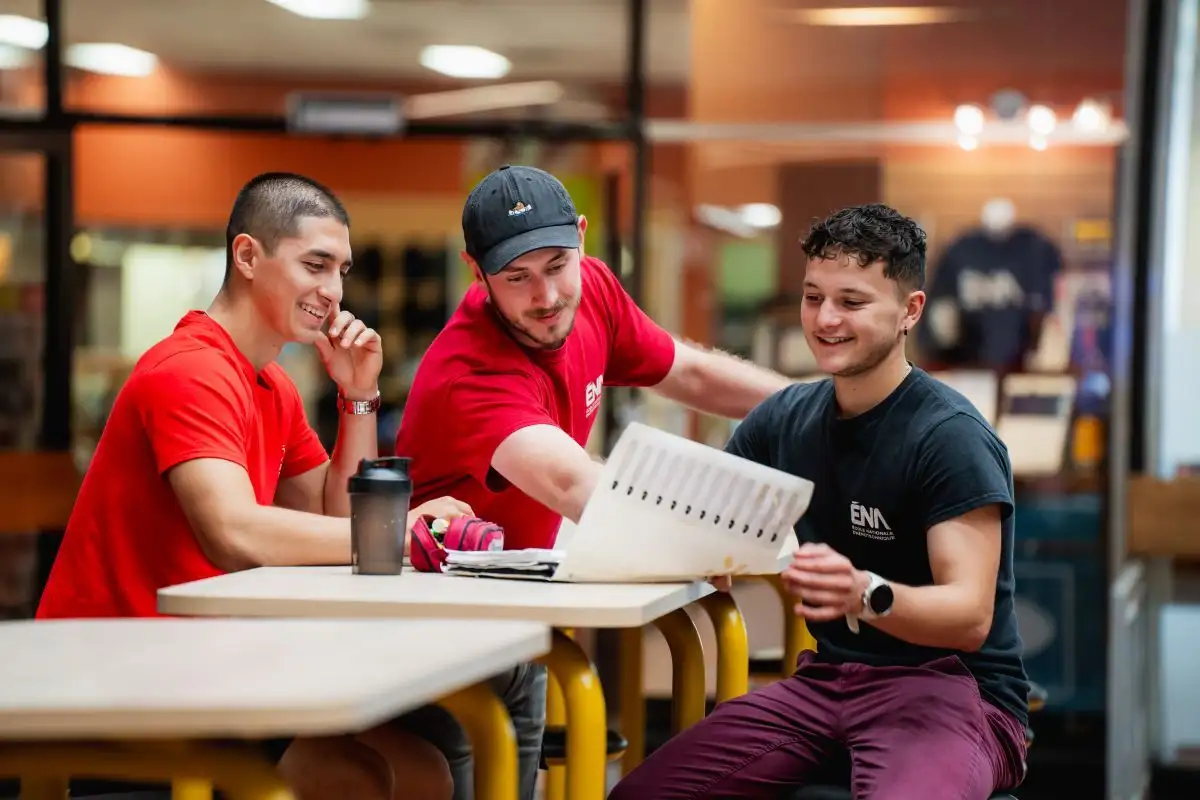
A complete college-level education on a unique campus.
General education is an integral part of all college programs. It aims to prepare students to live responsibly in society and to share the benefits of culture. All general education courses are offered on the École nationale d'aérotechnique campus.